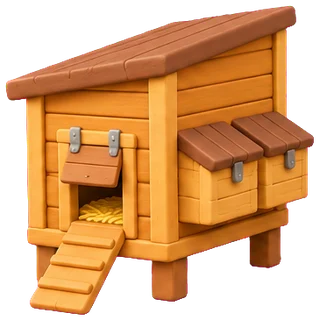
How many chickens fit in a 6 × 8 ft coop
A 6 × 8 ft coop (48 sq ft) holds 16 standard hens with a daily run, or 4 kept inside all day.
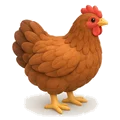 Standard hens16
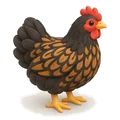 Bantams24
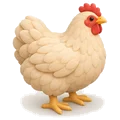 Large breeds13
- Standard, kept inside4
This footprint falls between smaller and larger common coop plans: changing the flock size by a few birds can shift the fit noticeably. For 16 standard hens, allow 160 sq ft outdoors. Indoor floor area governs the count because each bird needs space to move, perch, and reach feed; outdoor access changes the indoor allowance, not the coop’s 48 sq ft footprint.
Hens a 6 × 8 ft coop holds
Each number is how many hens fit. Recommended space per hen gives comfortable hens; the minimum is the least an extension service accepts, so more hens fit at the minimum than at the recommended space. Both come from the same floor and roost rules the planner uses.
| Bird size | With a daily run | Kept inside | ||
|---|---|---|---|---|
| Hens at recommended spaceAt rec. space | Most hens at minimum spaceAt min. space | Hens at recommended spaceAt rec. space | Most hens at minimum spaceAt min. space | |
| Bantam | 24 | 48 | 4 | 6 |
| Standard | 16 | 32 | 4 | 6 |
| Large | 13 | 24 | 4 | 6 |
The minimum rate is Penn State's 1.5 sq ft per hen with a run and Oregon State's 8 sq ft per hen kept inside. At those rates this coop holds up to 32 standard hens with a run, or 6 kept inside. In this coop the floor sets the count.
Plans that fit this footprint
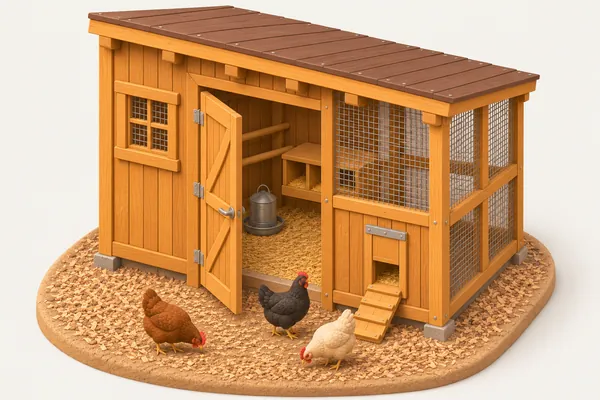 Walk-in coop
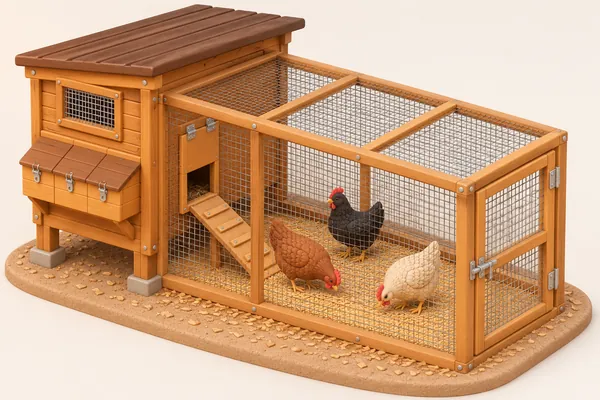 Coop with run
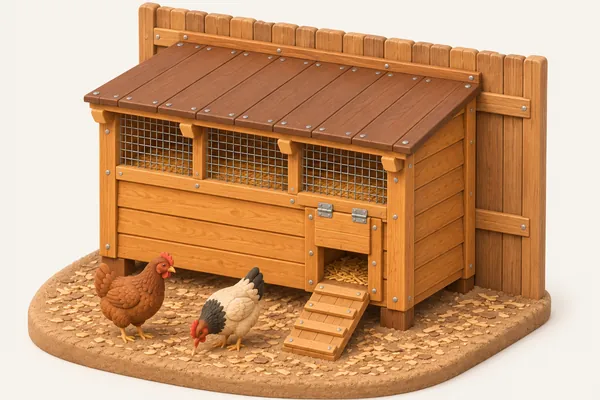 Lean-to coop
Smaller and larger breeds
This coop sits between the bantam and large-breed counts. With outdoor access, it holds 24 bantams at 3 sq ft each, while the minimum allowance of 1.5 sq ft each raises that number to 48. For large hens, the corresponding counts are 13 and 24. The smaller birds make more use of the same floor area, while larger birds bring the total down.
If hens remain indoors, breed size does not change the table’s counts: 4 at 10 sq ft each, or 6 at 8 sq ft each. Treat the higher count as a tighter allowance, and use the lower count when planning more room per bird.
Perches and nest space
At the 16-hen standard flock size, the drawing shows 2 roost bars and 4 nest boxes. That is a useful check when comparing this footprint with the next size up: the sleeping and laying fixtures change along with the flock they serve. Keep access to both clear, and leave the outdoor area outside the coop footprint when judging how much indoor floor remains.
Room to expand
For more than 4 standard hens, plan outdoor access instead of keeping the flock confined. The recommended allowance then fits 16, with 160 sq ft outside; the minimum allowance reaches 32 at 1.5 sq ft each and is tighter. If you want more birds indoors, choose a coop with a larger footprint. More floor area raises the indoor count, while extra outdoor space alone does not.
Check your own coop
Enter your exact size and bird type in the planner to see what fits and what is missing.
Check your own coopQuestions
What changes if standard hens are kept inside this 6 × 8 ft coop?
The indoor count is 4 at the recommended 10 sq ft for each hen. At the minimum of 8 sq ft each, it is 6. The lower count leaves more indoor floor area per bird.
How much outdoor space goes with 16 standard hens?
Allow 160 sq ft outside for 16 standard hens. Indoors, the 48 sq ft coop fits that flock at the recommended 3 sq ft for each hen. At 1.5 sq ft each, the minimum count is 32.
Why does this coop hold fewer large hens than bantams?
With outdoor access, it fits 13 large hens or 24 bantams at the recommended allowance. At the minimum of 1.5 sq ft each, the counts are 24 large hens and 48 bantams. Indoors, both sizes share counts of 4 or 6.